
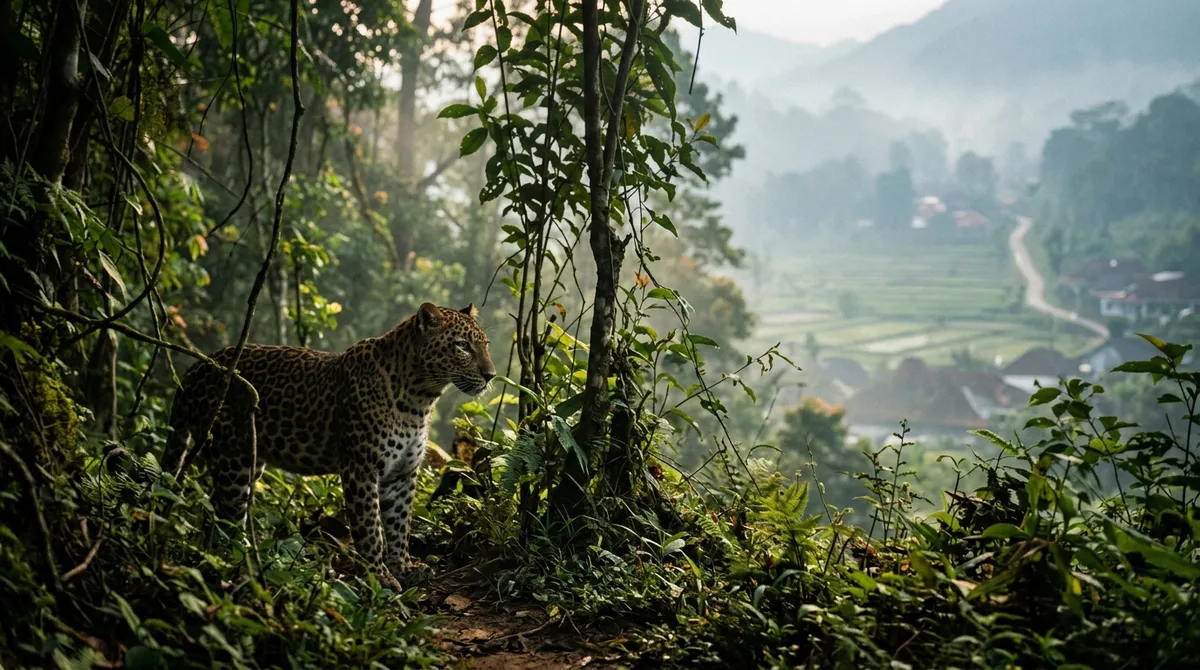
Against All Odds: The Javan Leopard's Remarkable Survival Story
In one of the most densely populated places on Earth, fewer than 350 Javan leopards are defying extinction odds that would doom most large predators. New research from the University of Twente reveals how these rare big cats manage to survive on Java, an Indonesian island home to over 150 million people, by adapting in ways that challenge conventional conservation wisdom.
The study, which employed camera traps and spatial modeling techniques, uncovers a surprising resilience strategy: rather than relying solely on pristine protected reserves, the Javan leopards are thriving by utilizing diverse prey sources and regenerating secondary forests that many conservationists previously overlooked.
Secondary Forests: The Unsung Heroes of Conservation
Perhaps the most striking finding challenges what conservationists have long believed about habitat quality. According to the research, secondary forests—areas where vegetation has regrown after disturbance—are proving just as critical to the leopards' survival as protected wilderness areas.
These "second-rate" regenerating forests are doing heavy lifting in conservation efforts, providing essential habitat corridors that connect fragmented landscapes. This discovery shifts the narrative from focusing exclusively on preserving pristine wilderness to recognizing the conservation value of recovering ecosystems.
The spatial modeling data reveals exactly where strategic reforestation efforts could create the most impact, offering planners actionable guidance for habitat restoration projects that could strengthen the species' survival prospects.
Navigating a Human-Dominated Landscape
Java presents a unique conservation challenge as one of the world's most crowded islands. Roads, railways, and expanding cities continuously fragment the remaining forest patches where leopards live. Yet the research demonstrates that these cats have developed remarkable adaptability, utilizing diverse prey sources to sustain themselves in an increasingly human-dominated environment.
The study's findings highlight how habitat connectivity through corridors linking fragmented areas becomes crucial for species survival. These pathways allow leopards to move between forest patches, access diverse hunting grounds, and maintain genetic diversity within their small population.
Beyond Protected Areas: A New Conservation Model
The Javan leopard's story illustrates why protected areas alone cannot save large predators in today's world. As large carnivores vanish globally due to habitat loss and human pressure, this research provides a rare glimpse into how some species can persist when conservation strategies extend beyond traditional reserve boundaries.
The leopards' ability to adapt to regenerating forests and maintain diverse diets suggests that conservation success requires a landscape-level approach. Rather than isolated protected zones, effective preservation demands creating networks of connected habitats that include both pristine and recovering ecosystems.
A Fragile Success Story
While the Javan leopard's resilience offers hope, researchers emphasize that this conservation success story remains fragile. With ongoing development pressure on Java's remaining forests, the window for implementing effective habitat corridors and reforestation projects is narrowing.
The spatial modeling results provide urgent, actionable guidance for planners and conservationists. By identifying specific locations where reforestation efforts and habitat corridors could make the biggest difference, the research offers a roadmap for strengthening the species' long-term survival prospects.
Lessons for Global Wildlife Conservation
Java serves as a microcosm of wildlife challenges facing human-dominated landscapes worldwide. The Javan leopard's survival strategy—adapting to secondary forests, utilizing diverse prey, and navigating fragmented habitats—offers valuable insights for conserving other large predators in similar situations.
As urbanization and development continue fragmenting natural habitats globally, understanding how species like the Javan leopard persist in crowded landscapes becomes increasingly important. Their story demonstrates that with strategic planning and recognition of secondary habitats' value, even the world's rarest big cats can find ways to coexist with dense human populations.
The research ultimately suggests that conservation in the 21st century requires moving beyond the traditional model of fortress-like protected areas toward more nuanced approaches that recognize the conservation potential of recovering and connecting fragmented landscapes.