
Breaking Archaeological Assumptions
A nearly 1,400-year-old skeleton has just rewritten what we thought we knew about violence in ancient societies. Meet T46—a Langobard woman whose bones tell a story that directly contradicts decades of archaeological interpretation.
Archaeologists have discovered the first skeletal evidence of interpersonal violence in a Langobard woman, according to reports. This finding is significant because it challenges the long-held assumption that warfare and violence were exclusively male experiences in Langobard society.
The Detective Work Behind T46
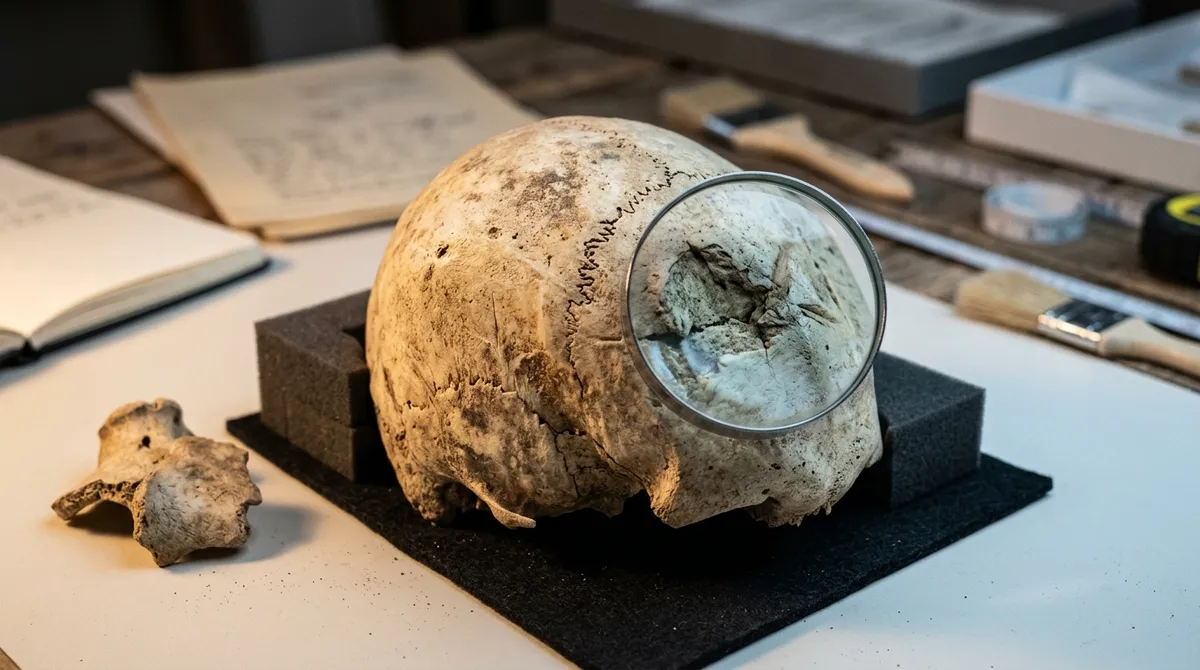
T46's story is remarkable not just for what happened to her, but for how researchers uncovered her identity. The skeleton showed evidence of surviving two severe head wounds—a blade slash and a crushing blow. When traditional bone analysis couldn't determine the skeleton's sex due to damage, scientists turned to protein analysis to confirm T46 was female.
This technological approach highlights how modern methods are revealing hidden stories in ancient remains that previous generations of archaeologists might have missed entirely.
The Historical Disconnect
What makes this discovery particularly intriguing is the disconnect between written records and archaeological evidence. According to reports, Langobard legal documents from the same period explicitly mention women engaging in and experiencing violence. Yet until now, archaeologists had found zero skeletal evidence of violence against women in Langobard remains.
This gap created what researchers now recognize as a false historical narrative—one that painted Langobard violence as an exclusively male domain despite legal texts suggesting otherwise.
Why Women's Violence Disappears from History
The absence of female violence in the archaeological record doesn't necessarily mean it didn't happen. According to reports, there are several reasons why women's experiences with violence leave fewer traces in skeletal remains:
- Household abuse typically bruises soft tissue rather than breaking bones
- Women were less likely to participate in armed raids where skeletal injuries were more common
- Different types of violence leave different archaeological signatures
T46's case is unusual because she survived severe head trauma that would have left permanent marks on her skull—the kind of evidence that can survive nearly 1,400 years.
A Story of Survival
Perhaps most remarkably, T46 didn't just survive her injuries—she lived for years afterward. According to reports, evidence suggests she received community care despite her severe trauma, challenging assumptions about how ancient societies treated injured women.
This survival story adds another layer to our understanding of Langobard society, suggesting more complex social support systems than previously recognized.
Implications for Historical Research
This discovery highlights how gaps in skeletal evidence can create false historical narratives and underscores the need to revisit assumptions about gender and conflict in ancient societies. It's a perfect example of how a single archaeological find can force scholars to reconsider established historical interpretations.
The case also demonstrates the importance of combining different types of evidence—legal documents, skeletal remains, and advanced scientific analysis—to build more complete pictures of the past.
Looking Forward
Researchers are now exploring new avenues to uncover more hidden cases of female violence in ancient societies. According to reports, future research directions include isotopic studies and ancient DNA analysis, which could reveal additional cases that traditional archaeological methods have missed.
T46's story reminds us that history isn't just about what we've found—it's about recognizing what we might have overlooked and being open to evidence that challenges our assumptions about the past.