
A Decade-Long Antarctic Mystery
Ten years ago, Bradley Markle, an assistant professor at the Institute of Arctic and Alpine Research at the University of Colorado Boulder, stumbled upon a puzzling pattern buried in Antarctica's temperature records. According to reports, this discovery has now led to groundbreaking research that could reshape our understanding of polar climate dynamics.
The mystery centered on why some regions of Antarctica experienced more dramatic temperature swings than others—a phenomenon that traditional climate models struggled to explain.
The Greenhouse Effect Takes Center Stage
The new research reveals that Antarctica's regional temperature changes are governed more by the nonlinear greenhouse effect than by the traditional Planck response, according to reports. This finding challenges long-held assumptions about how Earth's southernmost continent responds to climate variations.
The key discovery lies in water vapor's role as a climate amplifier. As temperatures rise in Antarctica's warmer regions, water vapor enhances greenhouse gas trapping, creating a feedback loop that makes these areas more sensitive to temperature changes. This explains why warmer Antarctic regions appear to warm or cool more dramatically compared to their colder counterparts.
Ice Cores: Windows into Climate History
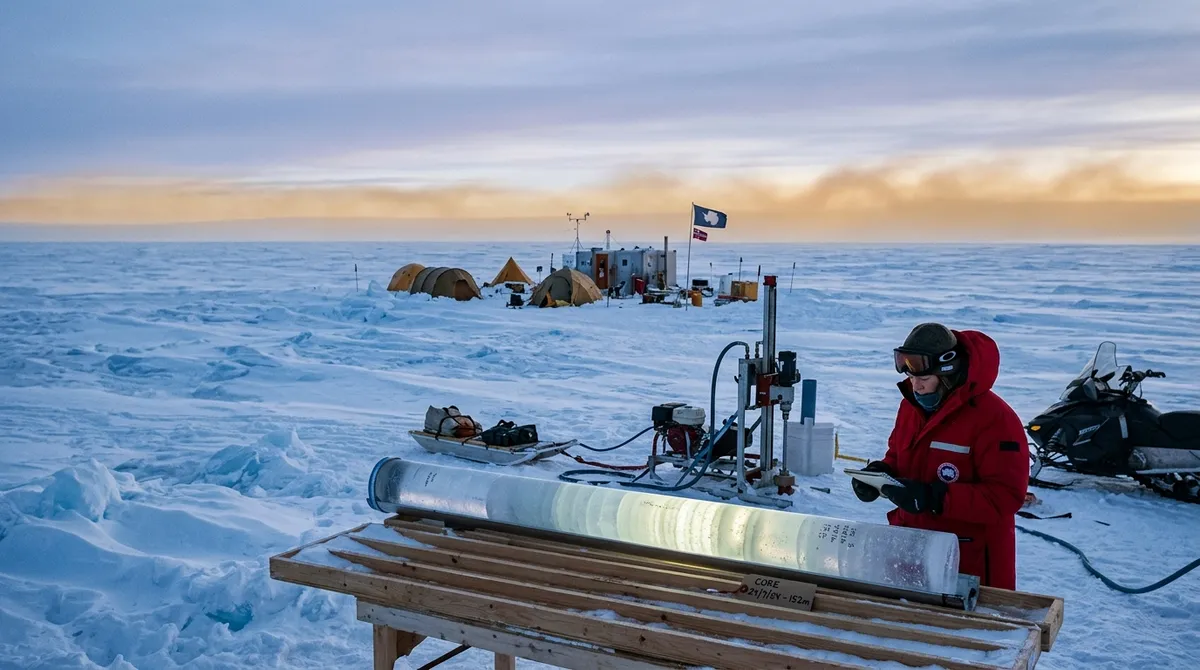
To solve this puzzle, researchers turned to paleoclimate records, particularly ice cores spanning an impressive 160,000 years of climate history. These ancient archives provided crucial data for understanding climate processes that are still playing out today, according to reports.
The ice core data revealed patterns that helped scientists understand why Antarctica doesn't warm evenly across its vast expanse. Instead of uniform temperature changes, the continent shows a complex response where different regions react with varying intensity to the same climate drivers.
Antarctica as Earth's Heat Regulator
This research positions Antarctica as something of Earth's "heat exhaust valve," according to reports. The continent's role in global climate systems appears more nuanced than previously understood, with different regions acting as varying degrees of temperature amplifiers based on their baseline conditions.
The nonlinear greenhouse effect means that small changes in atmospheric conditions can trigger disproportionately large responses in Antarctica's warmer areas. This discovery helps explain historical climate variations and provides new insights into how the continent has responded to past climate shifts.
Implications for Climate Modeling
As climate models attempt to predict Antarctica's response to modern warming trends, this finding could fundamentally reshape assumptions about polar climate dynamics. The research suggests that current models may need to better account for these regional variations and the amplifying effects of water vapor in warmer Antarctic regions.
The study's implications extend beyond academic understanding. With Antarctica holding the majority of Earth's freshwater ice, accurate predictions of its response to climate change are crucial for sea-level projections and global climate planning.
Looking Forward
This breakthrough represents more than just solving a scientific puzzle—it provides a new framework for understanding ice sheet history and future predictions. The research demonstrates how paleoclimate records can reveal hidden rules of the climate system that continue to influence conditions today.
By identifying why Antarctica's warmest regions may be more sensitive to change, scientists now have better tools for predicting how the continent will respond to ongoing global warming. This understanding could prove essential as researchers work to refine climate models and improve long-term environmental projections.
The decade-long journey from mysterious temperature patterns to a comprehensive understanding of Antarctic climate dynamics showcases how persistent scientific inquiry can unlock fundamental secrets of our planet's climate system.