
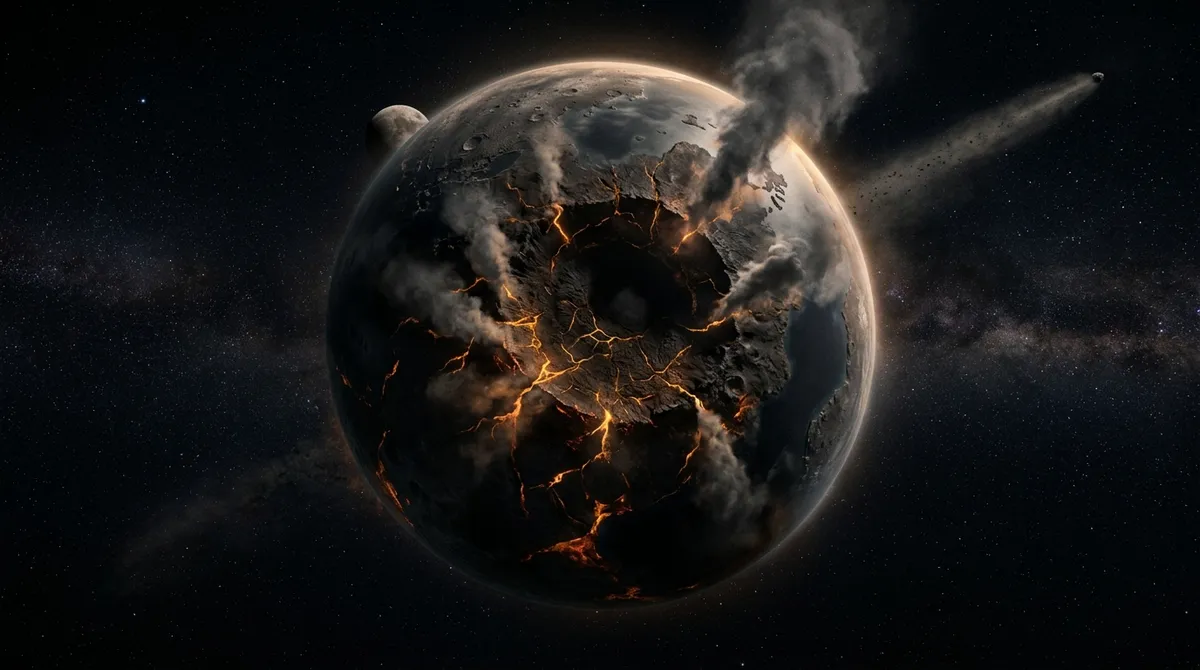
When Destruction Became Creation
The story of life on Earth just got a dramatic rewrite. New research suggests that the cosmic bombardment that pummeled our planet during its first billion years wasn't the obstacle to life we once thought—it may have been life's greatest enabler.
According to recent impact simulations, asteroid bombardment between 4.6 and 3.5 billion years ago did something remarkable: it fractured Earth's crust and created highly permeable zones extending up to 8 kilometers deep. These cosmic impacts, rather than making Earth uninhabitable, actually opened pathways that enabled fluid and gas circulation through rock—setting the stage for the chemical conditions necessary for life to emerge.
Reframing the Hadean "Hell"
This research fundamentally challenges the long-held "hellish early Earth" narrative that has dominated scientific thinking. During the Hadean and Archean eons, asteroids and planetesimals regularly bombarded our planet in what seemed like a cosmic assault course. Scientists have typically viewed this period as hostile to life's emergence.
But the new findings flip this perspective entirely. The very violence that appeared to make Earth uninhabitable was actually creating the underground plumbing system that life would need to get started. These impact-generated hydrothermal systems provided the perfect chemical laboratory for prebiotic chemistry to unfold.
The Science Behind the Discovery
Researchers used sophisticated impact simulations to reconstruct conditions from billions of years ago—a necessary approach since few rocks today are more than 4 billion years old. These shock physics models revealed how asteroid impacts created extensive fracture networks in Earth's crust, fundamentally altering the planet's subsurface structure.
The permeable zones created by these impacts allowed for crucial fluid circulation. This circulation system would have been essential for concentrating organic compounds, facilitating chemical reactions, and creating the temperature and pressure gradients that prebiotic chemistry requires.
Modern Analogues Tell an Ancient Story
To understand how these ancient systems might have worked, scientists can look to modern hydrothermal environments. Deep-sea vents and geothermal features like those in Yellowstone provide glimpses into the kind of chemical activity that may have occurred in Earth's impact-fractured crust billions of years ago.
These contemporary analogues show us how hydrothermal systems can concentrate organic compounds, drive chemical evolution, and create the kind of organized chemistry that could eventually lead to self-replicating systems—the hallmark of life.
Implications Beyond Earth
This research carries profound implications for astrobiology and the search for life beyond our planet. If asteroid impacts can create life-enabling conditions rather than destroy them, scientists may need to reconsider how they evaluate potentially habitable worlds.
Planets and moons that have experienced heavy bombardment—rather than being written off as hostile to life—might actually be prime candidates for harboring the chemical conditions necessary for biology to emerge. This framework could reshape how we approach the search for life on exoplanets or icy moons in our own solar system.
A New Chapter in Origin Stories
The paradox of cosmic destruction as creation adds a fascinating chapter to humanity's understanding of its own origins. Rather than life emerging despite Earth's violent youth, it appears life may have emerged because of it.
This research demonstrates how impact-generated hydrothermal systems likely provided the essential infrastructure for prebiotic chemistry during Earth's first billion years. As scientists continue to piece together the puzzle of life's origins, this work suggests that sometimes the most hostile environments can be exactly what emerging life needs to take its first steps toward complexity.
The cosmic bombardment that once seemed like Earth's greatest trial may have been its most essential gift—opening the pathways that would eventually lead to the rich biosphere we inhabit today.