
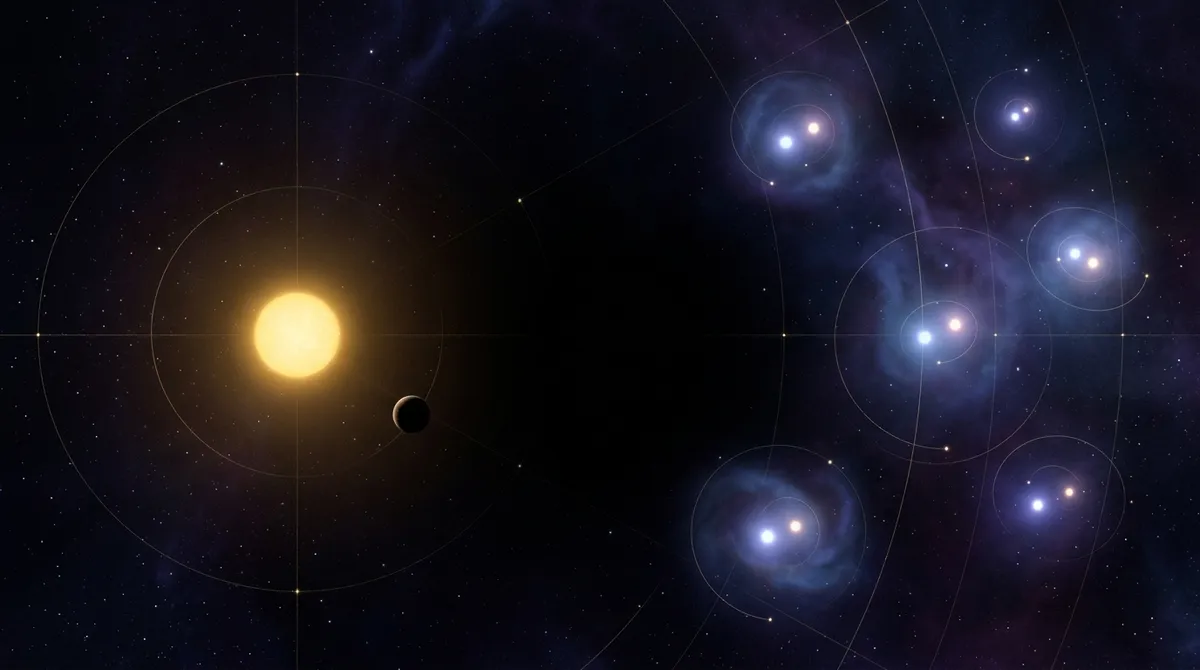
Our Sun is the Exception, Not the Rule
A groundbreaking new study published on arXiv has created what researchers call a "near-complete census" of multiple star systems within 10 parsecs of Earth, revealing that our solitary Sun is far from typical in the cosmic neighborhood. The comprehensive survey identified 424 stellar and sub-stellar objects organized into 92 bound multi-star systems, painting a picture of a universe where stellar companionship is the norm rather than the exception.
The findings challenge our Earth-centric view of stellar systems and have profound implications for humanity's ongoing search for habitable worlds beyond our solar system.
The Mass-Companionship Connection
According to the research, there's a clear relationship between a star's mass and its likelihood of having companions. Higher-mass stars demonstrate a strong tendency to exist in multiple star systems, essentially "traveling in packs" through the galaxy. In stark contrast, low-mass red and brown dwarfs typically remain solitary throughout their cosmic journey.
This mass-dependent behavior suggests that stellar formation processes and gravitational dynamics play crucial roles in determining whether stars end up with companions. The data reveals a fundamental pattern in how our local stellar neighborhood is organized, with massive stars forming complex gravitational relationships while smaller stars tend to go it alone.
Critical Implications for Exoplanet Hunting
The timing of this census couldn't be more important for astronomy. Next-generation exoplanet missions, including NASA's planned Habitable Worlds Observatory and the European Space Agency's LIFE mission, are being designed to detect Earth-like planets around nearby stars. However, binary star systems present significant complications for these searches.
According to reports, binary stars can effectively "sabotage" planet searches by creating observational challenges that waste precious telescope time. When stars have hidden companions, the gravitational interactions and combined light can mask or mimic planetary signals, leading to false positives or missed detections. This new census provides mission planners with clean target lists, helping them identify which nearby stars are truly single and therefore optimal candidates for exoplanet observation.
The Strange Reality of Stellar Relationships
The research reveals some fascinating details about how these stellar partnerships operate. Many binary star systems involve pairs that orbit each other over incredibly long timescales—sometimes millions of years—creating gravitationally bound relationships that persist across cosmic ages. These extended orbital periods mean that some stellar companions may be separated by vast distances while still remaining gravitationally linked.
This discovery adds another layer of complexity to our understanding of stellar evolution and planetary system formation. Stars in binary systems may experience different evolutionary paths compared to solitary stars like our Sun, potentially affecting their ability to host stable planetary systems where life could develop.
Reshaping Our Cosmic Perspective
The census data offers a compelling "our sun is the weird one" narrative that fundamentally shifts how we view our place in the universe. While humans have long considered our single-star system as the standard template, this research suggests we actually live in an unusual stellar environment.
This revelation has practical consequences beyond pure scientific interest. As we develop strategies for detecting potentially habitable worlds, understanding the true nature of our stellar neighborhood becomes crucial. The research provides a roadmap for future exoplanet missions, helping scientists focus their limited observation time on targets most likely to yield clear, unambiguous results.
Looking Forward
The completion of this definitive census within 10 parsecs marks a significant milestone in our mapping of the local universe. By cataloging which stars are single, paired, or part of complex multi-star systems, astronomers have created an essential reference tool for the next generation of space-based telescopes.
As these advanced instruments come online in the coming decades, this stellar census will serve as a foundation for targeting the most promising candidates in our search for Earth-like worlds—and potentially, signs of life beyond our solar system.