
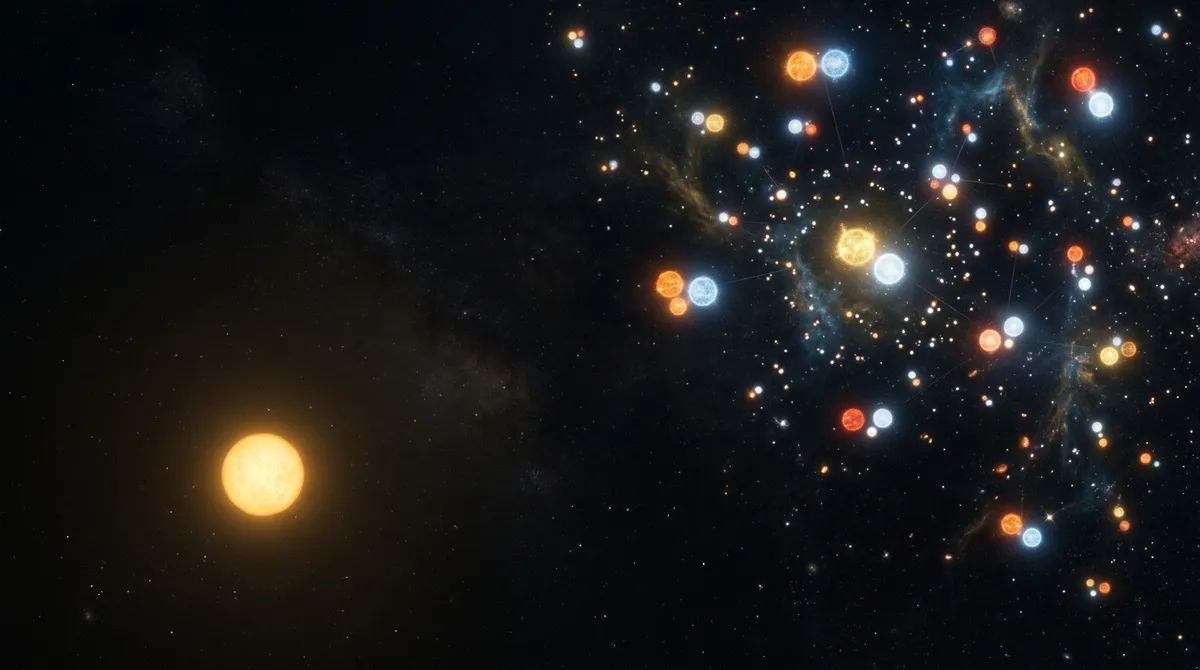
Our Sun Is Actually the Odd One Out
Our sun travels through space alone, without a stellar companion racing alongside it through the cosmos. While this might seem normal to us Earth-dwellers, new research reveals that our solitary star is actually the exception rather than the rule in our cosmic neighborhood.
A comprehensive arXiv study has created what researchers call a near-complete census of multiple star systems within 10 parsecs of Earth, cataloging 424 stellar and sub-stellar objects organized into 92 bound multi-star systems. The findings paint a picture of a universe where stellar companionship is the norm, not the anomaly.
The Surprising Reality of Stellar Relationships
According to the research, higher-mass stars show a strong tendency to have companions, essentially "traveling in packs" through space. Meanwhile, low-mass red and brown dwarfs typically remain solitary, similar to our sun. This discovery challenges our Earth-centric view of how stars behave in the galaxy.
The census reveals that massive stars are far more likely to have gravitational partners, some locked in orbital dances that can last millions of years. These stellar pairs and groups create complex gravitational environments that differ dramatically from our sun's isolated journey through space.
Why This Matters for Finding Earth-Like Planets
The timing of this stellar census couldn't be more critical for the future of exoplanet research. Next-generation missions like NASA's Habitable Worlds Observatory and ESA's LIFE telescope are preparing to search for potentially habitable worlds around nearby stars. However, binary stars and complex stellar systems can significantly complicate these searches.
According to reports, binary star systems can sabotage planet detection efforts, making it crucial for astronomers to know which stars are truly single versus those hiding stellar companions. Without accurate target lists, these expensive missions risk wasting valuable observation time on stars with hidden companions that could interfere with planet-hunting efforts.
The Local Neighborhood Map
This comprehensive mapping of our local stellar environment provides scientists with the clean target lists they desperately need. By identifying which nearby stars are genuinely solitary, paired, or part of complex multi-star systems, researchers can prioritize the most promising candidates for Earth-like planet searches.
The 10-parsec radius studied represents our immediate cosmic neighborhood, encompassing the stars most likely to host planets that future telescopes could study in detail. Understanding the gravitational dynamics of these systems is essential for planning observation strategies and interpreting data from planet-hunting missions.
What Makes Our Sun Special
The research reinforces the "our sun is the weird one" narrative that has emerged from astronomical studies. While we've known for some time that most stars have companions, this detailed census provides concrete numbers about our local stellar population. The fact that our sun lacks a stellar companion may have played a crucial role in allowing stable planetary orbits and, ultimately, the development of life on Earth.
Binary and multiple star systems can create gravitational chaos that disrupts planetary formation and destabilizes existing orbits. Our sun's solitary nature may be one of the factors that allowed Earth to maintain its stable orbit in the habitable zone for billions of years.
The Future of Exoplanet Discovery
As we prepare to launch increasingly sophisticated telescopes designed to directly image Earth-like exoplanets, this stellar census becomes an invaluable resource. The research helps astronomers understand which nearby stars offer the best chances of hosting stable, potentially habitable worlds.
The strange reality of stellar pairs orbiting over millions of years adds another layer of complexity to our understanding of planetary system formation and evolution. By mapping these relationships in our cosmic backyard, scientists can better predict where to look for the next potentially habitable world and how to interpret the signals these advanced telescopes will detect.