
The Economics of Lunar Construction
As NASA sets its sights on establishing a permanent lunar base by 2040, the economics of space construction present a staggering challenge. According to reports, shipping materials to the moon costs between $1 to $1.3 million per kilogram, making traditional Earth-based construction methods financially prohibitive for large-scale lunar settlements.
This economic reality has driven researchers at Texas A&M University to pioneer revolutionary construction technology that leverages the moon's own resources rather than relying on expensive Earth-shipped materials. The approach represents a fundamental shift from "flags and footprints" exploration to actual settlement infrastructure.
Building with Moon Dust
At the heart of this innovation is lunar regolith—the fine, rocky material covering the moon's surface. While this substance presents significant engineering challenges due to its hostile properties, researchers have identified it as the key to sustainable lunar settlement construction.
The Texas A&M Space Institute, a $200 million facility, has been specifically designed to replicate moon and Mars surfaces for testing these groundbreaking construction methods. This specialized environment allows researchers to develop and refine techniques for working with lunar materials under conditions that closely simulate the actual lunar environment.
Remote Construction Through Mixed Reality
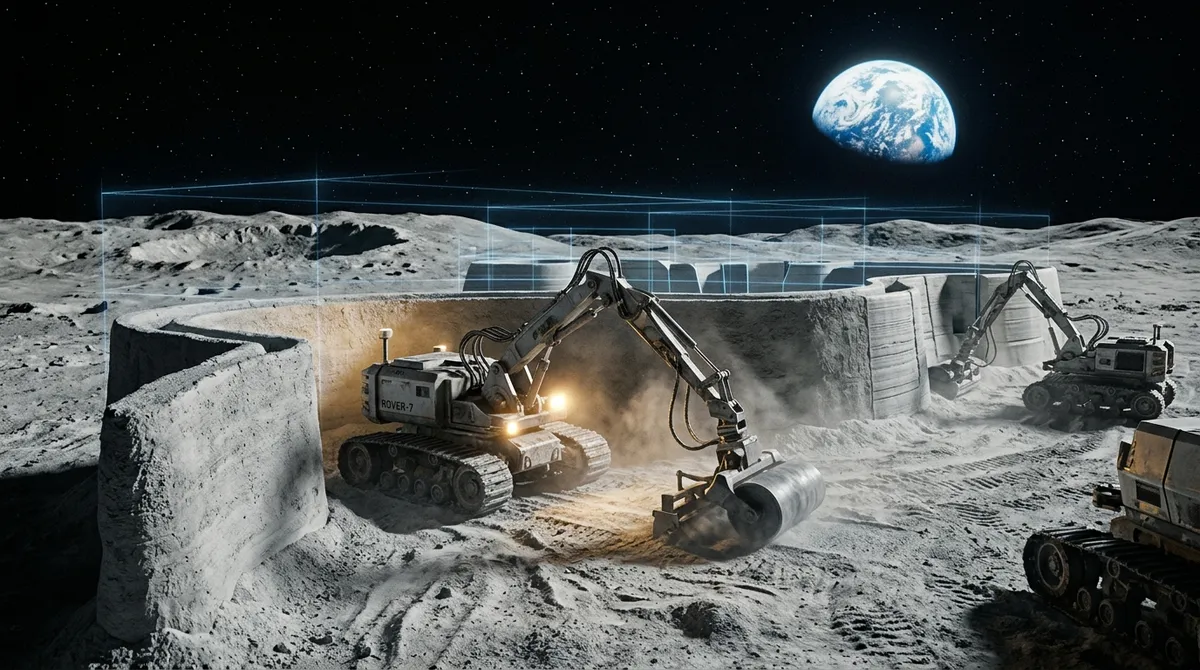
One of the most compelling aspects of this lunar construction approach involves the use of mixed-reality systems and semi-autonomous robots. According to reports, these technologies will enable engineers on Earth to control construction activities on the moon in real time, bridging the 240,000-mile gap between planets through advanced robotics and virtual reality interfaces.
This remote construction capability addresses one of the fundamental challenges of lunar development: the need to build complex infrastructure without requiring constant human presence on the lunar surface. The semi-autonomous nature of these systems means they can operate independently when needed while still allowing for human oversight and control when precise operations are required.
From Afghanistan to the Moon
The project benefits from unique expertise in extreme environment construction. Dr. Suermann, according to reports, has transitioned from building military bases in Afghanistan to designing lunar infrastructure, bringing valuable lessons learned from Earth's harshest construction environments to the challenges of space settlement.
This background in military construction provides crucial insights into building durable infrastructure under hostile conditions—experience that translates remarkably well to the extreme environment of the lunar surface, where construction crews must contend with temperature extremes, radiation, and the absence of atmosphere.
Autonomous Systems and Robotics Innovation
The development of autonomous construction methods represents a critical component of making lunar settlement economically viable. These robotic systems must be capable of handling the unique properties of lunar regolith while operating reliably in the harsh lunar environment.
The robotics being developed at Texas A&M focus on overcoming the specific challenges posed by lunar construction, including the abrasive nature of moon dust, extreme temperature variations, and the need for systems that can operate for extended periods without direct human intervention.
The Path to Permanent Settlement
This shift toward using in-situ resource utilization marks a pivotal moment in space exploration strategy. Rather than viewing lunar missions as temporary scientific expeditions, this approach treats the moon as a destination for permanent human habitation.
The Texas A&M Space Institute's work on lunar construction technology represents more than just engineering innovation—it's laying the groundwork for humanity's expansion beyond Earth. By solving the fundamental problem of how to build sustainably on the moon using local materials, these researchers are making the economic case for lunar settlement significantly stronger.
Looking Toward 2040
With NASA's 2040 timeline for a permanent lunar base, the urgency behind this research has intensified. The institutional breakthroughs in robotics and construction science happening at Texas A&M are directly addressing the practical challenges that must be solved before large-scale lunar settlement becomes reality.
The combination of economic necessity, technological innovation, and expertise from extreme environment construction is creating a unique opportunity to solve one of space exploration's most fundamental challenges. As this technology continues to develop, it may well prove to be the foundation upon which humanity's first permanent off-world settlements are built.